Lung cancer has the highest mortality rate and one of the worst five-year survival rates of all cancers. It is particularly deadly because symptoms are non-specific, and patients often only seek medical attention when tumours have exceeded a critical size, or when cancer cells have spread to the lymph nodes or have metastasised.
EarlyCDT Lung
How does EarlyCDT Lung work?
EarlyCDT Lung is a simple, non-invasive blood test that measures a panel of tumour-associated autoantibodies produced by the immune system in response to cancer proteins.
The test gives an overall result of Low, Moderate, or High risk. This result is then combined with a patient’s pre-test risk score to calculate a new Post-Test Risk of lung cancer. If a patient has a high-risk result, a CT scan is recommended.
Only a small volume of blood is needed, which can be taken in clinic or at home with a finger-prick test kit. Results are usually available within 10 days.
Clinical Value
EarlyCDT Lung has two key uses:
- Screening for lung cancer
Lung cancer is often only diagnosed when tumours are large, have spread to lymph nodes, or metastasised. At this point, curative treatment is far less effective. If lung cancer is detected early, before symptoms appear, the five-year survival rate can be as high as 90%. EarlyCDT helps identify patients at higher risk, allowing earlier scans and increasing the chance of curative treatment. - Assessment of indeterminate pulmonary nodules (IPNs)
CT scans can detect nodules, but if they are between 4–20 mm, they are too small to biopsy and are classed as IPNs. Patients with IPNs are usually placed on a “watch and wait” pathway with regular scans, but by the time the nodule is large enough for biopsy, curative treatment may no longer be possible. EarlyCDT helps stratify IPN risk, showing which patients may need earlier follow-up or further investigation.
How Early CDT Lung Fits in the Patient Pathway
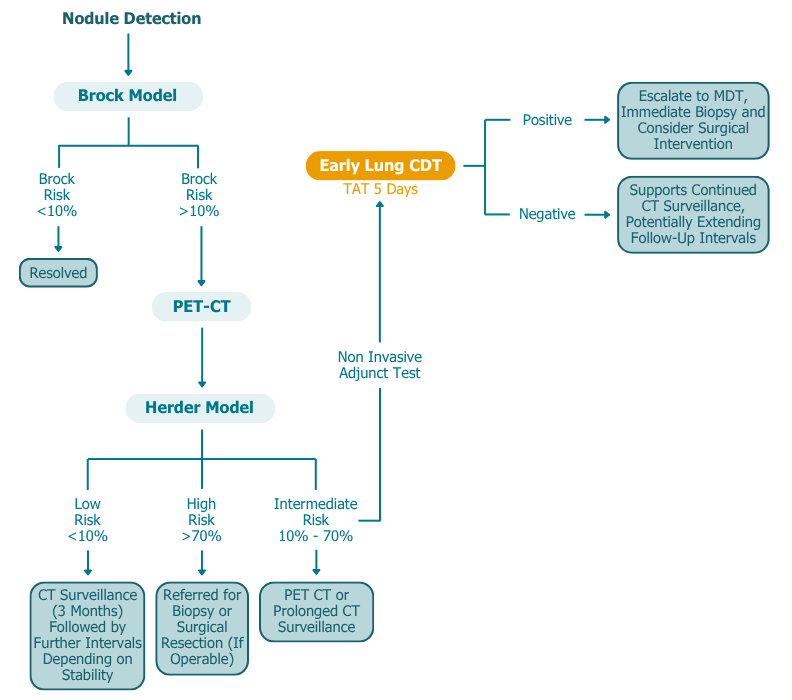
EarlyCDT Lung is a simple blood test designed for patients with indeterminate pulmonary nodules (IPNs) who fall into the intermediate-risk range (10–70%) based on existing Brock and Herder models of risk stratification. By providing a low, moderate, or high-risk result, EarlyCDT supports better decision-making, identifying high-risk IPN patients who should be escalated to MDT review and biopsy, and those at lower risk who can safely remain under CT surveillance.
Where to Access EarlyCDT Lung
You can access EarlyCDT through a private GP or consultant, by booking in for a consultation where the consultant will go through all your clinical data, family history, and discuss any concerns you have. They will take your blood sample and usually book a follow-up consultation to discuss the results. They will be able to guide any further monitoring or investigation, if required. You can request any private consultant or GP to contact us to organise an EarlyCDT test for you.
Innermost Healthcare
Cardiff, Wales
Innermost Healthcare
Private GP Healthcare
Ashford, Kent
Private GP Healthcare
Concierge Medical Practice
Wellesbourne, Warwick
Concierge Medical Practice
The Private Doctors
Leeds
The Private Doctors
Partnering with Your Clinic to Enhance Patient Care
Source Genomics provides clinics and healthcare providers with access to novel biomarker-driven tests across multiple cancer types. Partnering with us will enable access to:
Source Genomics partners with healthcare providers to integrate validated blood-based and genomic prostate cancer tests into patient pathways, from early risk assessment to treatment selection. Contact us today to connect with clinical specialists or request test implementation details.